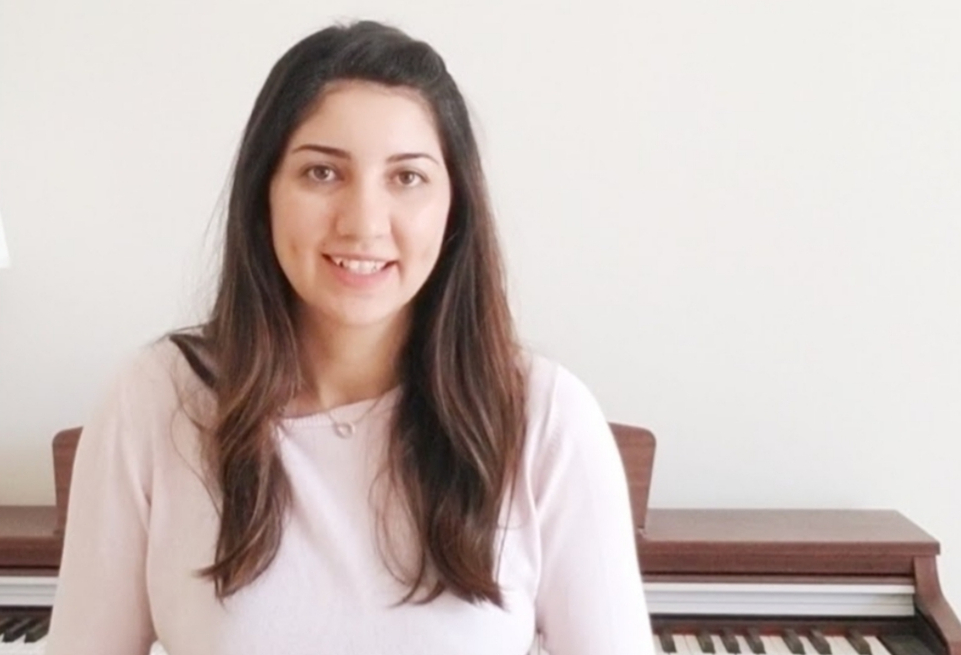
Have your ever wanted to learn piano and never did? It's your time now! Start from the very beginning , or pick up where you left off as a child and start your classes now. This well rounded beginner piano course has 7 step-by-step classes and 4 bonus classes guiding you through piano basics and music theory, and some music facts/ history as well.
By the end of the class you should be able to read music sheet, have an idea about how to perform well infront of your family and friends, and have a good foundation of music theory and history.
I'm Yasmine Habib. A private piano business owner for 6 years, taught for 6 years in 3 different countries. Certified from London's ABRSM university in music theory and practice and currently pursuing the highest grade in piano.
I originally studied Electronics Engineering (which I equally love and enjoy) but I made the decision to switch over to my artistic side and indulge in the joy of piano and music.
In my teaching years, I've gathered so many tricks to work smart when approaching the piano learning… I have gathered unlimited resources and ideas which I can't wait to share with all of you music enthusiasts!
This 7 class course (+ 4 bonus class) is the best way to jumpstart your way into piano practice and learn the basics for reading and playing music notes.
Piano layout
Reading Treble clef notes (Right Hand)
Reading Bass clef notes (Left Hand)
Accidentals (Black keys)
Learning Rhythm
Learning about music Eras and famous composers
Scales introduction
Tips and common mistakes
The course price is 750 Egyptian pounds. You'll have access to all 7 classes plus the 4 Bonus classes, 21 music sheets for practice, a Facebook group for members only, a direct channel with me for any questions you may have.
To register contact me at:
Info@yallapiano.com
Try to always scan your body while playing to see if you are applying the correct seating posture... otherwise, you may suffer from piano-related "injuries" (especially back and neck pains)... so take care of your body and sit well on the piano :)
Elbows: 90 degree angle
Knees: 90 degree angle
Feet: Flat on the floor
Shoulders: Relaxed down
Back: Straight!
Hands: in line with elbows
Fingers: curved, as if holding an orange
Elbows: bent too much
Knees: not 90 degrees
Feet: lifted or on tiptoes
Shoulder: tight and pulled up
Back: curved... thats the worst one!
Hands: over elbow line
Hands: Flat on the piano
We often hear the word sonata whenever we listen to classical music... so what does the word sonata mean? And what do we expect from the piece?
Sonata is a one of many forms of music (called Musical forms).
It's a phenomenon that many music players experience. .. muscle memory is truly fascinating ! It's when your hands just go on "auto pilot" when you have not played a piece in a while and you sit on the piano and suddenly your fingers just ... start playing the music! . . . Without any interaction from your mind at all! It's like a beautiful present that the piano gives to you 😀
But seriously, what happens is kind of similar to when you have not driven your car for a while (if you drive) and you start driving and that auto pilot muscle memory takes over... your hands and feet know what to do ... or when you are eating or drinking, you don't think about every tiny movement... it just happens...
If you leave it up to chance or mood, it will never be enough to progress... set 2 or 3 (or 5!) Days in the week and time of the day that you set the phone reminder to remind you to practice even for only 10 min. So for example it maybe Monday and Thursday at 8 pm (or any other time that may suit your schedule).
2. Making a practice routine
So you set the day and time for practice... then you sit on the piano and have no clue where to start. What you need is a practice routine. Start off with simple exercises (may be only CDEFG or the 5 finger exercises several times) to warm up the fingers. Next, will be the in class workout exercises (the numbered ones). After this start doing the practice song/s that are required for every class.
You don't need to finish all 3 steps at once, you can divide it on several sessions throughout the day!
3. Not having enough "fuel" 😀
And by fuel I mean food and drink. Yes! Piano takes alot of energy from you, so it's better to be well-rested and well-fed to have full energy for practice time.